Iron Throne
A Clash of KingsThe Iron Throne is the visible seat of royal power in Westeros, but the narrative repeatedly presents it as more than furniture or ceremonial decoration. It concentrates competing ideas of inheritance, conquest, obedience, and rule: Stannis Baratheon studies it as the object he believes he is legally owed, Renly Baratheon treats possession of it as a matter of force and political allegiance, and Tyrion Lannister discovers that even a physically uncomfortable throne can provide a commanding view over the court. Its authority is therefore inseparable from the violence that created it and the struggles that continue to surround it.
Origin and Physical Form
The Iron Throne was made for Aegon Targaryen in the days before the Conquest. In the great round chamber on Dragonstone, the Painted Table preserves the geography of the Seven Kingdoms, while the throne stands as the more immediate political consequence of bringing those kingdoms beneath one ruler. Its origin in conquest gives the object a historical ambiguity: it represents a unified realm, but that unity began through domination rather than peaceful succession.
The throne’s material form rejects ease. It is described as a tangled mass of barbs and jagged metal teeth, with steps that make Tyrion Lannister’s stunted legs cramp as he climbs. The shape turns the weaponry of defeated enemies into a seat, but the resulting object remains visibly hostile to the body that occupies it. The Iron Throne does not conceal the violence of kingship beneath polished comfort; it makes power look wounded, sharp, and dangerous.
Claims and Contestation
For Stannis Baratheon, the Iron Throne is the endpoint of a legal and dynastic claim. Looking across the Painted Table toward the painted position of King’s Landing, he broods over the realm he seeks to claim, describing it as near at hand yet far away. He regards himself as the rightful king, even while acknowledging that the great lords have chosen other candidates, including Joffrey Baratheon, Renly Baratheon, and Robb Stark. His plan to send one hundred seventeen copies of his letter throughout the realm is an attempt to make the throne’s legitimacy legible to every lord, maester, port, holdfast, and fishing village.
Stannis’s appeal exposes the gap between right and possession. The Iron Throne may be his by his understanding of succession, yet he has only Dragonstone and a few islands, while the political machinery of the realm rests elsewhere. His language makes the throne an absent center: the object is physically located in King’s Landing, but its meaning is disputed across the entire kingdom. The fact that his letters may be read and then burned shows that recognition, not merely lineage, determines whether the throne can function as authority.
Renly Baratheon offers the opposing logic of conquest and allegiance. He argues that Robert Baratheon won the throne with his warhammer and that his own claim is therefore as good as Robert’s. In this view, the Iron Throne belongs to the ruler capable of taking and holding it, not necessarily to the person with the strongest hereditary argument. Renly is willing to confirm a defeated lord in lands, titles, and honors, even permitting the title of King in the North so long as fealty, loyalty, service, and homage are rendered to him. The throne thus becomes the point at which flexible local identity must yield to a single superior power.
The Throne as a Stage of Rule
When Tyrion Lannister sits upon the Iron Throne while acting in royal authority, its height becomes its immediate attraction. The climb causes him physical discomfort, and he is conscious of how absurd he may look, yet the elevation allows him to look down upon the guards, courtiers, supplicants, and nobles gathered in the hall. The object’s political power is conveyed through a bodily change in perspective: from the throne, Tyrion occupies a position above the court and finds that he enjoys the view.
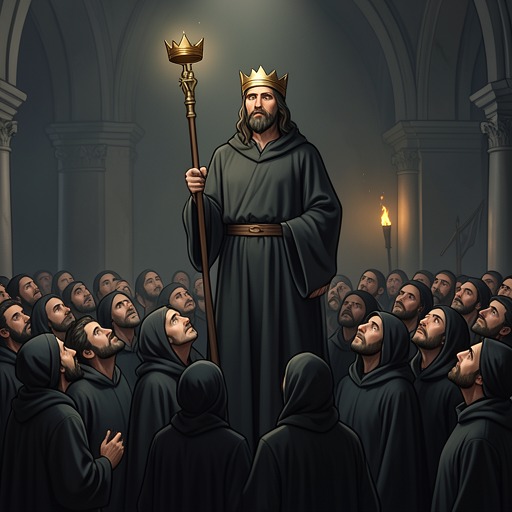
The hall around the throne reinforces its function as a theater of power. Lannister guardsmen in crimson face the gold cloaks, the steps are flanked by Bronn and a Kingsguard knight, and courtiers and petitioners fill the space below. Tyrion’s command that Ser Cleos Frey be called forth rings through the hall, and he takes pleasure both in being heard and in being seen from above. The Iron Throne converts administrative action into spectacle, making the authority to summon, judge, and preside visible to everyone present.
Ceremony, Succession, and Political Performance
The throne also serves as the setting for the formal transfer and display of power. Joffrey Baratheon publicly asks Tywin Lannister to govern the realm until the young king comes of age, and Tywin accepts before taking his place at the council table. The Hand’s chain is fastened around him after his armor is removed, turning the ceremony into an image of delegated sovereignty: Joffrey remains seated as king, but effective governance is placed in Tywin’s hands.
The same ceremony uses the throne to absorb military success into royal legitimacy. Tywin arrives in burnished red armor with golden ornament, a lion-crowned helm, a gilded horse, and crimson Lannister barding; after the formal embrace and proclamation naming him Savior of the City, he is installed as Hand. The grandeur is undercut by the destrier dropping dung at the foot of the throne, a comic intrusion that briefly exposes the physical and mundane world beneath the pageantry. Yet the ceremony continues, showing how swiftly royal ritual can transform victory, embarrassment, and family power into an official image of order.
Joffrey then receives Mace Tyrell, Loras Tyrell, and Garlan Tyrell, fastening golden rose chains bearing the Lannister lion around their throats. His declaration that the roses support the lion makes the political alliance explicit: Highgarden’s wealth and strength are represented as supports for the royal house. The Iron Throne is therefore not only a seat for the king; it is the fixed center around which subordinate houses are publicly arranged, rewarded, and symbolically bound.
Significance
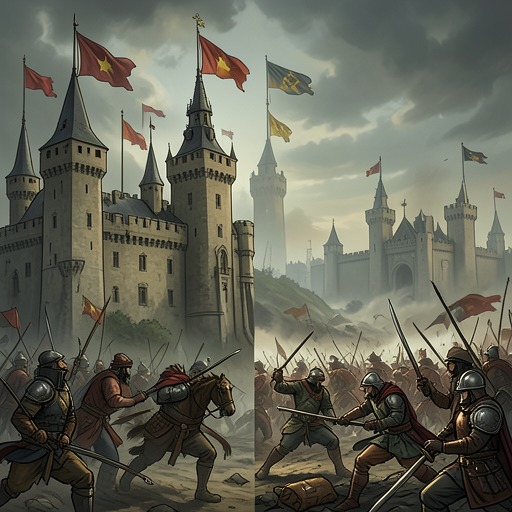
The Iron Throne embodies a contradiction at the heart of Westerosi politics. It promises a single, elevated authority, yet its construction records the violence of conquest and its surface remains hostile to anyone seeking comfort. Stannis’s claim emphasizes law, Renly’s emphasizes force and fealty, and the court ceremonies emphasize performance, alliance, and delegated power. Each interpretation depends on the same object while revealing a different answer to the question of why a ruler should be obeyed.
Its recurring presence also links private bodily experience to public sovereignty. Stannis stands over the painted realm in frustrated contemplation; Tyrion climbs painfully and enjoys the advantage of height; Joffrey uses the throne’s setting to stage the submission and incorporation of powerful allies. The object makes kingship tangible, but never secure. Whoever sits above the court must still contend with the jagged legacy beneath the seat, the competing claims beyond the hall, and the political belief that alone can turn metal into a throne.